
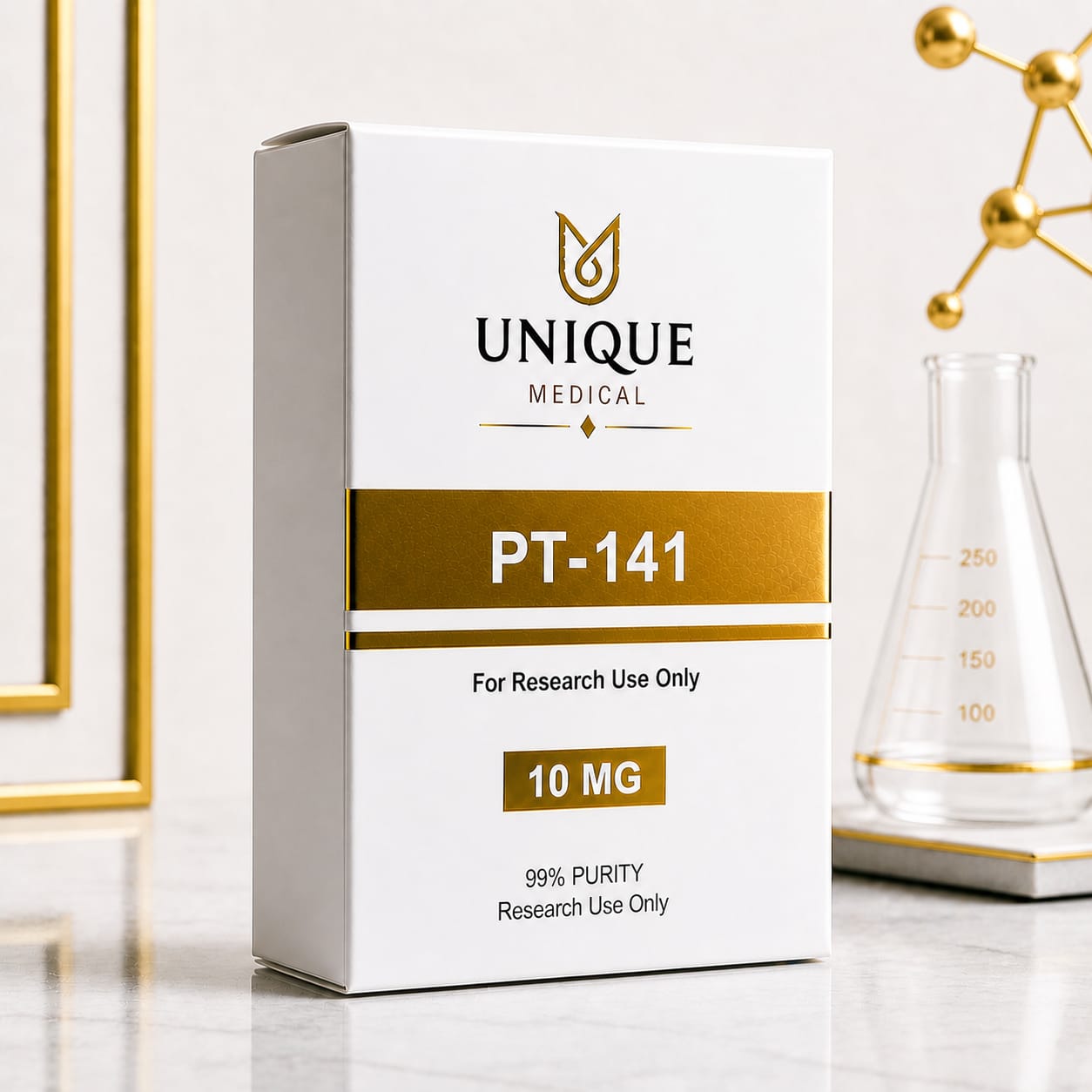
PT – 141 10MG
Please register or log in to view price.
PT-141 (Bremelanotide) is a synthetic peptide analog derived from α-melanocyte-stimulating hormone (α-MSH), functioning primarily as an agonist of melanocortin receptors, with high affinity for the MC4 receptor subtype. Through this mechanism, PT-141 modulates central nervous system pathways associated with sexual behavior, arousal, and motivation.
It is widely utilized in in vitro and preclinical research models to investigate neuroendocrine regulation, dopaminergic signaling, and melanocortin-mediated pathways involved in sexual function and behavioral responses. Its activity is linked to downstream effects on neuronal signaling cascades and receptor-mediated modulation of physiological responses related to libido and arousal.
For research use only. Not for human consumption.
Additional information
Research Applications
1. Neuroendocrine Modulation & Melanocortin Signaling Dynamics
Preclinical studies have investigated PT-141 in central nervous system models focusing on melanocortin receptor activation, particularly MC4R-mediated pathways. Experimental endpoints include neuronal activation patterns, modulation of hypothalamic signaling, and downstream effects on behavioral responses. These models are used to evaluate how melanocortin receptor agonism influences neuroendocrine integration and physiological response regulation.
Related mechanistic literature describes receptor-binding assays and in vitro systems evaluating PT-141 as a selective modulator of melanocortin pathways, supporting its application as a probe for central signaling mechanisms linked to motivation and arousal.
2. Dopaminergic & Neurotransmitter Pathway Interaction Studies
PT-141 has been explored in preclinical models assessing its interaction with dopaminergic and serotonergic systems. Studies evaluate neurotransmitter release patterns, receptor cross-talk, and signaling cascades involved in behavioral modulation. These frameworks support its use as a research tool to investigate neurochemical regulation of motivation, reward pathways, and central arousal mechanisms.
3. Behavioral Response & Sexual Function Models
In vivo experimental models have examined PT-141 in the context of behavioral neuroscience, with endpoints including sexual motivation, arousal response, and behavioral conditioning. These studies focus on central (non-vascular) mechanisms, distinguishing melanocortin-driven responses from peripheral pathways. Data from these models contribute to understanding CNS-mediated behavioral regulation.
4. Receptor Binding & Signal Transduction Analysis
Receptor-ligand interaction studies evaluate PT-141 binding affinity and activation of melanocortin receptors, particularly MC3R and MC4R. Downstream signaling pathways, including cAMP production and intracellular signaling cascades, are analyzed to map receptor activation profiles and pharmacodynamic characteristics in controlled laboratory systems.
5. Central Nervous System Activation Mapping
Neuroimaging and molecular studies in preclinical settings investigate PT-141-induced activation of specific brain regions associated with behavioral and endocrine regulation. These include hypothalamic and limbic structures, providing insight into spatial and functional activation patterns following receptor engagement.
6. Endocrine & Hormonal Response Models
Experimental frameworks have explored PT-141’s influence on hormonal signaling axes, including interactions with hypothalamic-pituitary pathways. Studies assess potential modulation of endocrine responses and feedback mechanisms under controlled conditions, supporting its relevance in neuroendocrine research.
7. Translational Behavioral Research Models
PT-141 has been utilized in translational research to bridge molecular signaling with observable behavioral outcomes. These models integrate receptor pharmacology, neurochemical modulation, and physiological responses, contributing to a broader understanding of peptide-driven CNS activity.
⚠️ Important Warnings and Disclaimers
Product Guidelines
- Product intended for experimental and research purposes only.
- Not for human consumption.
- Do not use without proper technical knowledge.
- Handle and store according to laboratory safety protocols.
- Keep refrigerated as per storage guidelines.
- Results may vary depending on experimental conditions and model systems.
- Keep out of reach of children.
- Do not reuse vials or materials.
- Do not purchase if unsure about appropriate research use.
Limitation of Liability
The company is not responsible for:
- Misuse or incorrect handling
- Adverse reactions or unintended outcomes
- Improper storage or non-compliant experimental use
The purchaser assumes full responsibility for all risks associated with handling and utilization.
📌 Legal Compliance
This product is marketed strictly as a research chemical in accordance with standard laboratory supply practices.
Its sale does not constitute or imply suitability for medical, veterinary, or human use.