
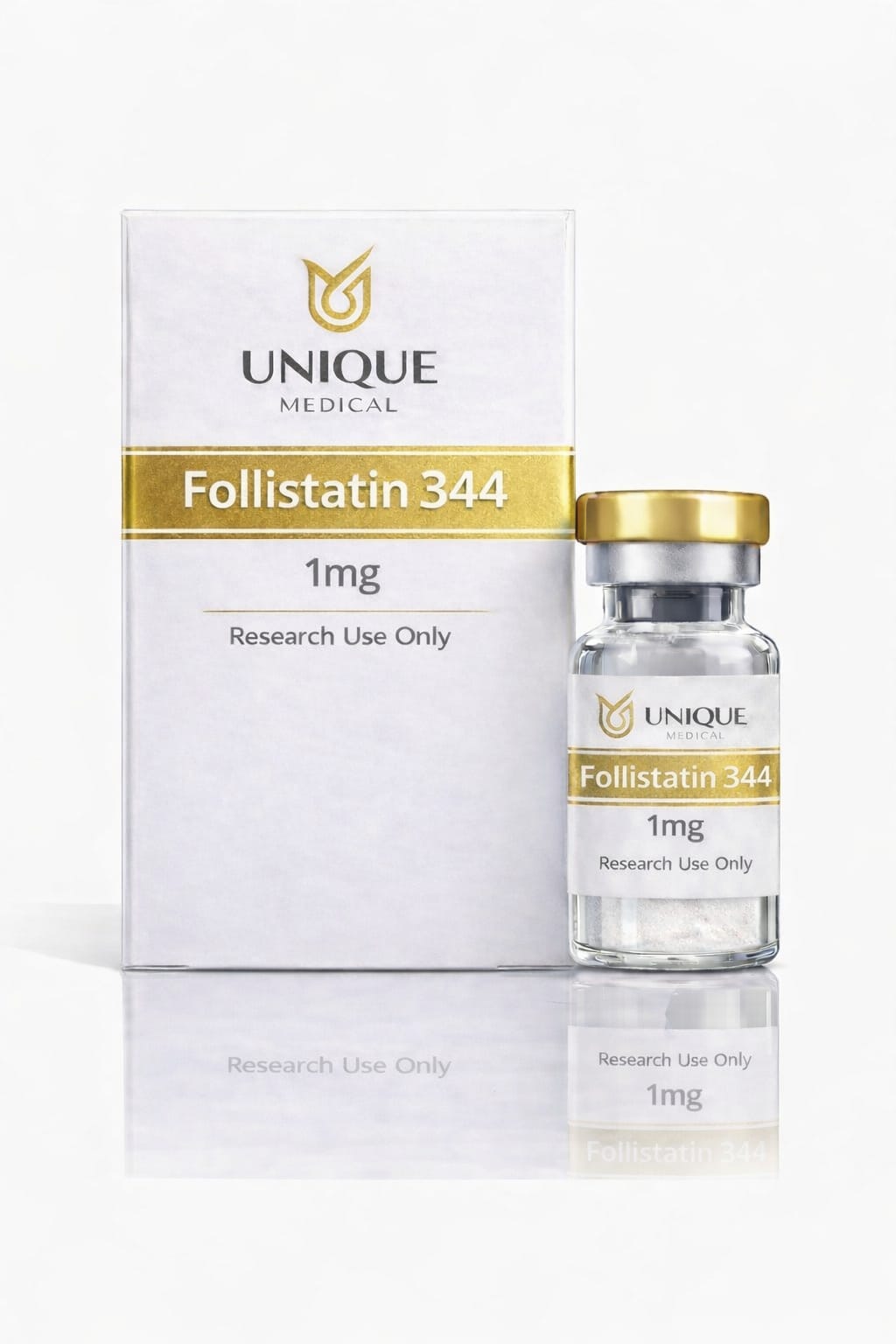
FOLLISTATIN 344 1MG
$380.00 Original price was: $380.00.$220.00Current price is: $220.00.
Follistatin 344 is a recombinant isoform of follistatin, a glycoprotein that functions as a high-affinity binding protein for members of the transforming growth factor-beta (TGF-β) superfamily, particularly myostatin (GDF-8) and activins. By binding to and neutralizing these ligands, Follistatin 344 modulates signaling pathways involved in muscle growth, differentiation, and cellular proliferation.
It is widely used in in vitro and preclinical research models to study the regulation of myogenesis, tissue regeneration, and the inhibition of catabolic signaling pathways associated with muscle wasting. Its activity is commonly associated with downstream effects on SMAD signaling and other regulatory mechanisms governing cell growth and repair.
For research use only. Not for human consumption.
Additional information
Research Applications
1. Skeletal Muscle Hypertrophy Models & Myostatin Inhibition Dynamics
Preclinical studies have investigated Follistatin 344 in rodent skeletal muscle models with endpoints including muscle fiber cross-sectional area, satellite cell activation, and suppression of myostatin (GDF-8) signaling. These experimental designs are used to evaluate how follistatin-mediated ligand sequestration influences anabolic signaling and muscle regeneration-associated gene expression profiles.
Related mechanistic literature characterizes the inhibition of myostatin/activin pathways and describes in vitro assays evaluating follistatin inputs as modulators of muscle cell proliferation and differentiation, supporting their use as pathway probes in myogenic systems.
2. Activin Signaling Modulation as a Mechanistic Anchor
In receptor-ligand interaction studies, Follistatin 344 has been evaluated for its high-affinity binding to activins and myostatin, preventing receptor engagement and downstream SMAD2/3 phosphorylation. These data support its use as an experimental tool for mapping TGF-β superfamily signaling outputs and transcriptional responses in controlled preclinical systems.
3. Gene Expression & Long-Term Modulation Models
In time-course and gene delivery studies, sustained expression of follistatin isoforms (including FS344-derived constructs) has been explored to assess prolonged inhibition of catabolic signaling pathways. These models are used to investigate transcriptional regulation, muscle growth persistence, and systemic versus localized effects under controlled experimental conditions.
4. Muscle Wasting & Cachexia Models
Preclinical research has examined Follistatin 344 in models of muscle atrophy, including disease-associated cachexia and disuse conditions. Endpoints include preservation of lean mass, modulation of ubiquitin–proteasome pathway markers, and attenuation of protein degradation signaling, providing insight into anti-catabolic pathway regulation.
5. Fibrosis & Tissue Remodeling Studies
Bioengineering and disease-model studies have evaluated follistatin-mediated inhibition of activin signaling in fibrosis-related pathways. Experimental designs measure extracellular matrix deposition, fibroblast activity, and TGF-β–associated remodeling markers in tissues such as muscle, liver, and lung under controlled laboratory conditions.
6. Bone Metabolism & Osteogenic Differentiation
In vitro and animal studies have explored the role of Follistatin 344 in bone biology, particularly its interaction with activin signaling in osteoblast differentiation and mineralization processes. These models assess markers of bone formation and remodeling, supporting its use in skeletal system research.
7. Reproductive Biology & Endocrine Signaling
Follistatin is widely studied in reproductive and endocrine systems due to its regulatory effects on follicle-stimulating hormone (FSH) via activin binding. In vitro and in vivo models investigate granulosa cell function, hormone signaling balance, and feedback mechanisms within the hypothalamic–pituitary–gonadal axis.
8. CNS & Neuroprotective Research Contexts
Preclinical literature has explored follistatin expression and activin inhibition in central nervous system models, including neuronal injury and neurodegenerative conditions. Studies focus on cell survival signaling, neuroinflammation markers, and regenerative responses in controlled experimental systems.
⚠️ Important Warnings and Disclaimers
Product Guidelines
- Product intended for experimental and research purposes only.
- Do not use without proper technical knowledge.
- Keep refrigerated as per storage guidelines.
- Results may vary based on experimental conditions and model systems.
- Keep out of reach of children.
- Store according to technical instructions.
- Do not reuse vials or materials.
- Do not purchase if you have any doubts regarding its use.
Limitation of Liability
The company is not responsible for:
- Misuse or incorrect administration.
- Adverse reactions or interactions with other substances.
- Consequences resulting from improper handling or non-research use.
The buyer assumes full responsibility for all risks associated with handling and utilization.
📌 Legal Compliance
This product is marketed strictly as a research chemical in accordance with standard laboratory supply practices. Its sale does not constitute or imply suitability for medical, veterinary, or human use.